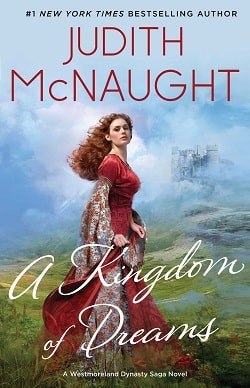
He shrugged. “The key word there iswilling, lass. If you don’t eat, you won’t be strong enough to make another attempt to escape.” He dug into his pouch and pulled out two large strips of dried venison. One, he chewed on. The other he broke in half and offered to Isabail.
She resisted for several heartbeats.
Then she darted forward, snatched the meat from his hands, and retreated to her corner of the hut.
“You’ll not benefit from the fire over there,” he said, with a shake of his head.




“I’m fine.”
“Nay, you’re not.” The woman still wore her damp clothes. If she did not dry out, he’d be tending to two invalids, not one. Aiden crossed the room in an easy stride, grabbed her about her slender waist, and hauled her over to the fire. He forced her down onto a blanket before the flames. “Eat, then sleep.”
Then he stepped away, seeking his own pallet.
Isabail stared at him, her face pale. But she remained where she was, her feet almost instinctively reaching toward the fire. The room was quiet for a while, with only the crackle of the fire and the chew of dried meat.
Then, with a hesitant voice, Isabail asked, “Is he all right? The man I hit?”
“Graeme? Aye.”
“I feared I might have killed him.”
Aiden snorted. A rock wielded by a sturdy milkmaid, perhaps. But not one hefted by a will-o’-the wisp like Isabail Grant. Graeme would face a great deal of ribbing over being felled by the likes of her.
“Sneer if you’d like,” she said quietly, “but I am not like you. I do not murder people with an easy conscience.”
Aiden tossed her a hard look. “Be careful, lass. You know naught of what you speak.”
“You deny you killed my brother?”
“I do.”
She shook her head lightly. “Do you deny slaying the king’s courier, too? My brother said they found the necklace in your chamber.” How easily those accusations spilled from her lips. Like they were an absolute truth.
All the rage he’d contained for months suddenly poured through Aiden’s veins like molten steel, sending him to his feet. Isabail cringed, and he swiveled to avoid the fear on her face. He was too angry to be kind. “The accusations made against me are sheer madness. Why would I poison my own kin? Why would I steal from a king while his courier was feasting under my own roof? Only a fool would do such a thing, and I assure you, I am no fool.”
Crossing the room to a wall hung with antlers from bygone hunts, he did his best to contain the fury that burned in his chest... and failed. He punched the wall with a heavy fist, sending antlers crashing to the floor.
“Eight of my kin died that night, including the wife of my cousin Wulf and her wee son, Hugh. No necklace, no matter how grand, could be worth the loss of those lives.” He closed his eyes, picturing the faces of those who were lost that night, one by one. Most of the dead had been very young or very old. The healthier sorts had sickened, but survived. Except for Elen and Henry de Coleville, both very fond of eel soup—they’d consumed two bowls.
He opened his eyes and stared at the dent his fist had left in the wattle and daub wall. “‘Twas your brother who caused their deaths.”
“Nay,” she said vehemently. “That’s not possible. If you knew my brother, you would never say such a thing.”
Aiden pivoted. “One of the men who accompanied Henry de Coleville to Dunstoras was also at Lochurkie the next morning. I saw him when your brother arrested me.”




She frowned. “Of what relevance is that? All of the king’s men came to Lochurkie after the murder of de Coleville.”
“I spied this one in the corridor leading to my chamber. He hid the necklace there.”
Her lips thinned. “A rather far-fetched tale. Why would anyone go to such lengths?”
“To discredit the MacCurrans.”
Her eyebrows lifted. “Your clan is small, and your land is mostly mountains. What could they possibly gain?”
A very good question. One Aiden had given much thought to in the months since the necklace was stolen. But he was still no closer to an answer. His father had been a staunch supporter of the king, even from the early days of his minority, and he had spent a fair amount of time at the king’s side—but more as a warrior than a political ally. Compared to the Comyns, the Balliols, and the Bruces, the MacCurrans had little influence. They were renowned for their battle skills, but these were peaceful days in Scotland—the Norse had been conquered and England had ceased to play their wicked games of control, at least for a time.
But some sort of treachery was afoot. “You know the name of the man I seek.”