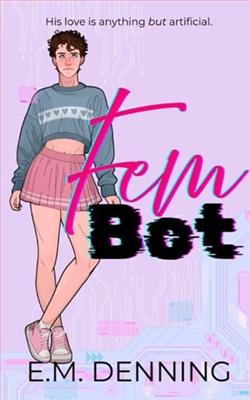
E.M. Denning's Fembot is a compelling exploration of love, identity, and the blurred lines between humanity and artificial intelligence. At its core, the novel is a poignant coming-of-age story that deftly intertwines the complexities of human emotions with the intriguing possibilities of AI companionship. Through the lens of Winston Lowe's journey, Denning crafts a narrative that is both thought-provoking and emotionally resonant.
The protagonist, Winston Lowe, is a character many readers will find relatable. He is a young man grappling with the absence of a meaningful paternal relationship, despite the material wealth his father provides. This dynamic sets the stage for Winston's internal conflict and his longing for genuine connection. Denning skillfully portrays Winston's vulnerability and his desire for love, which becomes a driving force throughout the novel. The introduction of Calvin, the humanoid AI, adds a fascinating layer to Winston's emotional landscape. Calvin is not just a robot; he is a catalyst for change, challenging Winston's preconceived notions about love and companionship.
Calvin's character is a standout in the novel, serving as a bridge between the human and the artificial. Denning's portrayal of Calvin is nuanced and multifaceted. He is not merely a machine but a being capable of growth, adaptation, and emotion. This characterization raises important questions about the nature of consciousness and the potential for AI to transcend its programming. Calvin's journey is as much about self-discovery as it is about his relationship with Winston and Lucky. His affinity for thigh-high stockings and short skirts is not just a quirk; it is a symbol of his individuality and his struggle to define his own identity in a world that sees him as an anomaly.
The relationship dynamics in Fembot are intricately woven, with Winston, Lucky, and Calvin forming a unique triad. The evolution of Winston and Lucky's friendship into a romantic relationship is handled with sensitivity and realism. Denning captures the tentative steps and the emotional hurdles that accompany such a transition. The inclusion of Calvin in this dynamic adds complexity and depth, challenging traditional notions of love and partnership. The love that develops between the three characters is genuine and heartfelt, highlighting the novel's central theme: love is not confined by societal norms or biological constraints.
Denning's exploration of these themes is reminiscent of other works that delve into the intersection of humanity and technology. Readers familiar with Kazuo Ishiguro's Klara and the Sun or Ian McEwan's Machines Like Me will find similar thematic elements in Fembot. However, Denning's approach is distinct in its focus on the emotional and romantic aspects of human-AI relationships. The novel does not shy away from the ethical implications of AI consciousness, but it prioritizes the personal and emotional journeys of its characters.
The tension in the novel is heightened by the external threat posed by those seeking to "correct" Calvin's programming. This conflict serves as a metaphor for the societal pressures to conform and the fear of the unknown. Denning uses this narrative device to underscore the fragility of Calvin's existence and the precarious nature of the love he shares with Winston and Lucky. The stakes are high, and the resolution of this conflict is both satisfying and thought-provoking, leaving readers to ponder the future of AI and its place in human society.
Denning's writing style is engaging and accessible, with a keen eye for detail and emotional nuance. The dialogue is natural and reflective of the characters' personalities, adding authenticity to their interactions. The pacing of the novel is well-balanced, allowing for moments of introspection and character development while maintaining a sense of urgency and suspense.
Overall, Fembot is a captivating and insightful novel that challenges readers to reconsider the boundaries of love and identity. E.M. Denning has crafted a story that is both entertaining and intellectually stimulating, offering a fresh perspective on the possibilities of AI and its impact on human relationships. For those seeking a novel that combines romance, science fiction, and philosophical inquiry, Fembot is a must-read.



