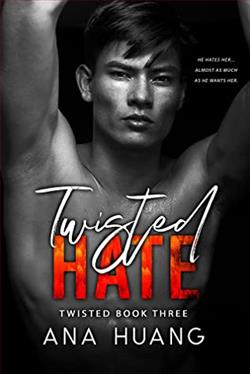
Twisted Hate is the third installment in Ana Huang's compelling Twisted series, a collection that dives deep into the chaotic but irresistible world of love, hate, passion, and redemption. Known for her ability to weave complex relationships and multifaceted characters, Huang doesn't disappoint with this latest addition. In this novel, she explores the tempestuous relationship between Jules Martinez and Alex Volkov, characters who previously simmered in the background of the series’ earlier books. What Huang accomplishes with Twisted Hate is nothing short of remarkable — crafting a narrative that is both thrilling and emotionally resonant.
From the very beginning, the chemistry between Jules and Alex is palpable. Their relationship is founded on a bedrock of antagonism, where each verbal exchange is as sharp and cutting as a knife. Jules, with her fiery independence and sharp wit, is a formidable match for Alex, whose complex persona oscillates between cold indifference and intense passion. Huang expertly navigates their dynamic, pushing the boundaries of their "enemies-to-lovers" trope into darker, more passionate territory. This intense dynamic is one of the book's most gripping aspects, providing a raw, almost voyeuristic look into the power play and eventual unravelling of their emotional guards.
One of the novel’s strengths is its deep psychological insight into what drives both Jules and Alex. Huang delves into their pasts, uncovering traumatic experiences and vulnerabilities that have shaped their personalities and reactions towards each other. This background enriches the narrative, adding layers of complexity to their interactions and making their eventual coming together a payoff that feels both hard-earned and inevitable. The characters are fleshed out with such care and detail that they step off the page as real, flawed individuals trying to navigate the murky waters of love and forgiveness.
Huang also incorporates a suspenseful subplot involving criminal undertakings and dark secrets that compels the story forward and adds a facet of thrill and danger to the romance. This subplot ties beautifully into the main romantic arc, enhancing the stakes and adding a sense of urgency to the characters’ development and decisions. The integration of this subplot demonstrates Huang's skill not only as a romance writer but also as a crafter of genuinely engaging, multifaceted narratives.
The writing style of Twisted Hate is vivid and evocative. Huang’s prose is rich, capable of capturing the subtleties of emotional turmoil as well as the intense, sometimes violent imagery of Alex and Jules’ world. Her ability to create vivid scenes, whether they are charged confrontations or moments of tender vulnerability, keeps the reader captivated and deeply invested in the fate of her protagonists. Additionally, Huang sprinkles the dialogue with sharp, witty exchanges that provide relief without detracting from the novel’s overall intensity.
However, while Twisted Hate shines in characterization and plot, some readers might find the pacing a bit uneven in parts. The middle section of the book, dense with emotional and psychological exploration, might seem slow to those more drawn to the novel's action and suspense elements. Yet, this depth is precisely what sews the fabric of Jules and Alex’s story into something genuinely memorable and moving. Furthermore, the explicit content, integral to the narrative’s raw honesty, might not be to everyone's taste, but it is handled with a deftness that aligns well with the book’s darker themes.
In conclusion, Twisted Hate is a powerhouse of a novel. Ana Huang has taken the themes of love, trauma, and redemption and melded them into a story that thrills and touches in equal measure. For fans of the series, this book offers a deeper, more intense continuation of the world they’ve grown to love. For newcomers, it’s a compelling entry into Huang's work, full of emotional depth, captivating characters, and a twisty plot that promises to keep you on the edge until the very last page. While it navigates darker territories of human experience, it does so with a sensitivity and boldness that marks Huang as a significant voice in contemporary romance writing.



